We continue our tour of the Caldwell objects. We're almost done. If you've diligently followed this guide and have found all the listed objects, you have already surpassed the 70-object minimum required for the Caldwell Silver Award. If you missed a few of the belly crawlers (like C87), you may be a few short. We'll add to your total this month and next to be sure you have covered as many of the targets as possible. As usual, the objects listed this should be easily visible between the onset of darkness until at least 1 am unless otherwise noted. if you missed the October objects, most can still be viewed. Info can be found here.
Caldwell 56 (NGC 246, The Skull Nebula) - [00h, 47.0m; -11°, 53']. Images reveal this planetary nebula to have a skull-like appearance. The nebula appears symmetrical and large - emcompassing an area containing several stars (I counted 6). It's an easy find - about 1.5 degrees south(ish) from both Phi1 and Phi 2 Ceti (the 3 form an almost perfect equilateral triangle).
Caldwell 62 (NGC 247) - [00h, 47.1m; -20°, 46']. C62 is a somewhat irregular, somewhat spiral galaxy about 12M light-years from Earth. It's part of the Sculptor group of galaxies. It's moderately faint with a disorganized core. Look for the galaxy about three degrees SSE of 2nd magnitude Deneb Kaitos ('the tail of Cetus').
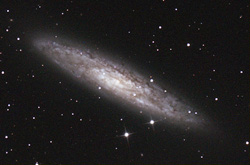 Caldwell 65 (NGC 253, The Scultor Galaxy) - [00h, 47.6m; -25°17']. Move your scope 4.5 degrees due South of NGC 247 and you'll encounter NGC 253. This magnificent spiral galaxy (shown at right) is bright (mag. 8) and nearly edge-on. It will appear very elongated and you could see traces of dust along the edge of the disc.
Caldwell 70 (NGC 300) - [00h, 54.9m; -37°, 41m]. C70 is another spiral galaxy in the Sculptor Group. It looks a lot like M33, but being 4x further away, it is smaller (and a bit dimmer at mag. 9). It's a little harder to find than the previous targets lying mid-way between Sculptor and Phoenix. It's fairly low in the South, so the Las Cruces sky fog may somewhat interfere with your observing. Probably good to wait a bit past 11 pm when the galaxy has moved far enough west to emerge from the Las Cruces Nebula. A finder chart can be found here.
Caldwell 51 (IC 1613) - [01h, 04.8m; 02°, 07']. An irregular dwarf galaxy in Cetus. You'll have to really work to earn this target. IC 1613 is fairly large, but has a very low surface brightness. It can be found about 6 degrees south of Epsilon Piscium. It's so faint that background galaxies can be imaged through it. Good luck!
Caldwell 13 (NGC 457, The Owl Cluster) - [01h, 19.1m; 58°, 20']. NGC 457 is a really neat open cluster in Casseopeia. The cluster very much resembles an owl with two bright eyes and wings spread upwards at 45 degree angles. It's an easy find - just 2 degrees SSW of mag 2.6 Ruchbah - one of the bright stars making up the '3' or 'W' of Casseopeia.
Caldwell 8 (NGC 559) - [01h, 29.5m; 63°, 18']. C8 is an open cluster about 3 degrees north of Ruchbah. It's fairly small, and not very bright (mag. 9.5), but has a reasonable surface brightness. Several dozen stars are packed into this 4.4 arc-minute cluster.
Caldwell 10 (NGC 663) - [01h, 46.0m; 61°, 15']. C10 is another open cluster in Casseopeia. It's fairly bright (mag. 7.1) and contains a few hundred stars. I easily saw a few dozen through my 16". It's also found near Ruchbah - this time around 1.6 degrees ENE.
That's it for this month's tour. Just 7 more targets to go!




