The Next ASLC Meeting is:
Friday, June 27, 2025
@ 7:00 pm (MDT)
Speaker: Khagendra Katuwal (NMSU)
Presentation: Mood Swings of the Sun: How Our Star Affects Life on Earth
Location: Meetings are now being held at the Mesilla Valley Radio Club 'Shack' (6609 Jefferson Ln, Las Cruces) and via ZOOM. Zoom Link for the meeting: click here
Contact the Club President for additional information
q
Upcoming Observing Opportunities:
ASLC MoonGaze
Downtown Plaza de Las Cruces
July 5, 2025
Dark Sky Observing @ Leasburg Dam SP
(ASLC Observatory at LDSP)
July 19, 2025
Dark Sky Observing @ Rockhound SP
(Rockhound SP)
(dark until fall, 2025)
Dark Sky Observing @ City of Rocks SP
(Gene and Elizabeth Simon Observatory)
(dark until fall, 2025)
Quick Links
|
Welcome!
 Greetings from the professional and amateur astronomers who comprise the Astronomical Society of Las Cruces (ASLC). The club was formed in 1951 by a group of dedicated astronomers including Clyde Tombaugh, who had discovered Pluto just 21 years earlier. For over 70 years, we've been sharing a little bit of the universe with our community under our beautiful Southern New Mexico skies. Greetings from the professional and amateur astronomers who comprise the Astronomical Society of Las Cruces (ASLC). The club was formed in 1951 by a group of dedicated astronomers including Clyde Tombaugh, who had discovered Pluto just 21 years earlier. For over 70 years, we've been sharing a little bit of the universe with our community under our beautiful Southern New Mexico skies.
The club has a variety of ongoing observing, education and public outreach programs. We host a public Moongaze and a dark sky observing event each month. We offer beginning astronomy education and support countless star parties for schools, scouts and various organizations. We also hold a meeting each month which includes a featured presentation.
To learn more about our society, please click here or select from the tabs above or the 'Quick Links' on the left.
The Clyde W. Tombaugh Lecture Series
 As part of our monthly meetings, the ASLC features a presentation by an astronomy enthusiast willing to share their expertise. Speakers are often astronomy professionals, researchers, students or leaders in the astronomy/space industries. The lecture series also gives ASLC members an opportunity to highlight their knowledge and experience; ASLC is fortunate to have several individuals who are doing exciting work. Topics vary from observing basics to optics systems, space tourism, cosmology... Join us for our next informative presentation (details below). Individuals interested in participating in the series should please contact the Club President. As part of our monthly meetings, the ASLC features a presentation by an astronomy enthusiast willing to share their expertise. Speakers are often astronomy professionals, researchers, students or leaders in the astronomy/space industries. The lecture series also gives ASLC members an opportunity to highlight their knowledge and experience; ASLC is fortunate to have several individuals who are doing exciting work. Topics vary from observing basics to optics systems, space tourism, cosmology... Join us for our next informative presentation (details below). Individuals interested in participating in the series should please contact the Club President.
The next Tombaugh Series presentation is Friday, June 27, 2025 - 7:00 pm (MDT)
Scheduled Speaker: Khagendra Katuwal (NMSU)
Presentation Title: Mood Swings of the Sun: How Our Star Affects Life on Earth
Summary: This talk takes a journey through our amazing star, the Sun, starting from its hot core and moving out to its outer atmosphere. It explains how the Sun creates energy deep inside, how that energy moves through different layers, and how it eventually escapes into space. The talk also explores what makes the Sun active at times, including sunspots, solar flares, and dark patches called coronal holes. These solar events can affect life on Earth, creating beautiful auroras, but also causing problems for satellites and communication systems. Learn how the Sun’s changing behavior connects to everyday life here on our planet.
Short Bio: Khagendra Katuwal is a Ph.D. candidate in the Department of Astronomy at New Mexico State University. His research focuses on the formation, expansion, and evolution of coronal holes, open magnetic field regions on the Sun that drive the solar wind and influence space weather. Originally from Nepal, he earned an M.S. in Physics from the Central Department of Physics, Tribhuvan University. He moved to the U.S. in 2021 to pursue a Ph.D. in Astronomy, taking on the significant challenge of switching fields driven by his belief in himself and his passion for space science. He is passionate about science outreach and education. He serves as an Ambassador for the Daniel K. Inouye Solar Telescope (DKIST), the world’s largest solar telescope. He actively demonstrates leadership through organizing outreach efforts, mentoring students, and fostering scientific collaboration. He is dedicated to public engagement and teaching, with a strong commitment to sharing scientific knowledge and inspiring the next generation.
Meetings are also streamed via ZOOM. Zoom link: click here
Did you miss a recent presentation? Since July 2020, ASLC has recorded and archived mp4 videos of our Tombaugh Series Lecturers' presentations. Click here to see what's available.
Cataclysmic Variable Star will Soon 'Explode Into Life' - Where to Find It
 Roughly once every 79 years, a small dim star in Corona Borealis briefly roars into life brightening by nearly 1000 fold. The star is T Coronae Borealis (aka The Flare Star) and it is one of over 1600 known cataclysmic variable stars that dot our night sky. Roughly once every 79 years, a small dim star in Corona Borealis briefly roars into life brightening by nearly 1000 fold. The star is T Coronae Borealis (aka The Flare Star) and it is one of over 1600 known cataclysmic variable stars that dot our night sky.
Cataclysmic variable stars are small hot (white dwarf) stars that orbit around large cool red giant stars. The stars are close enough together that the gravity from the white dwarf attracts a stream of hydrogen from its accompaning red giant. In time the amount of hydrogen attracted to the white dwarf reaches a critical temperature and pressure and nuclear fusion occurs - rather suddenly. The last flaring occured in 1946 during which time the star was estimated to brighten from magnitude 10 to about magnitude 2.5 - nearly as bright as the belt stars in Orion. The flaring (nova) only lasts a short time - on the order of days to weeks. Then the star returns to its dim (but hot) white dwarf state.
It's impossible to know exactly when the event will occur, but the star has recently gone through a couple of changes that indicate that a nova is imminent. It could happen during 2025 or even as late as early 2026. In reality, the nova occured a few thousand years ago, but the star is so far away (~3000 light-years) that the light from this event is just now approaching Earth.
The star should be visible after 11:30 pm during February (2025) and two hours earlier each month thereafter. It's not hard to find. Look for Arcturus (the bright star in Bootes) then use the map/inset to localize the proper region (click on the map for a larger version). With luck, you could be the first person on the planet to observe the brightening. Happy observing!
Walter H. Haas Observatory Dedication
ASLC recently dedicated its observatory located at Leasburg Dam State Park in honor of the late Walter H. Haas, who among other notable achievements founded The Association of Lunar and Planetary Observers (ALPO). Mary Alba, Walter's daughter, recently recorded some thoughts about her father and the dedicating of the observatory in his honor. You can listen to her interview here.
Planning a Visit to Southern New Mexico's Dark Skies?
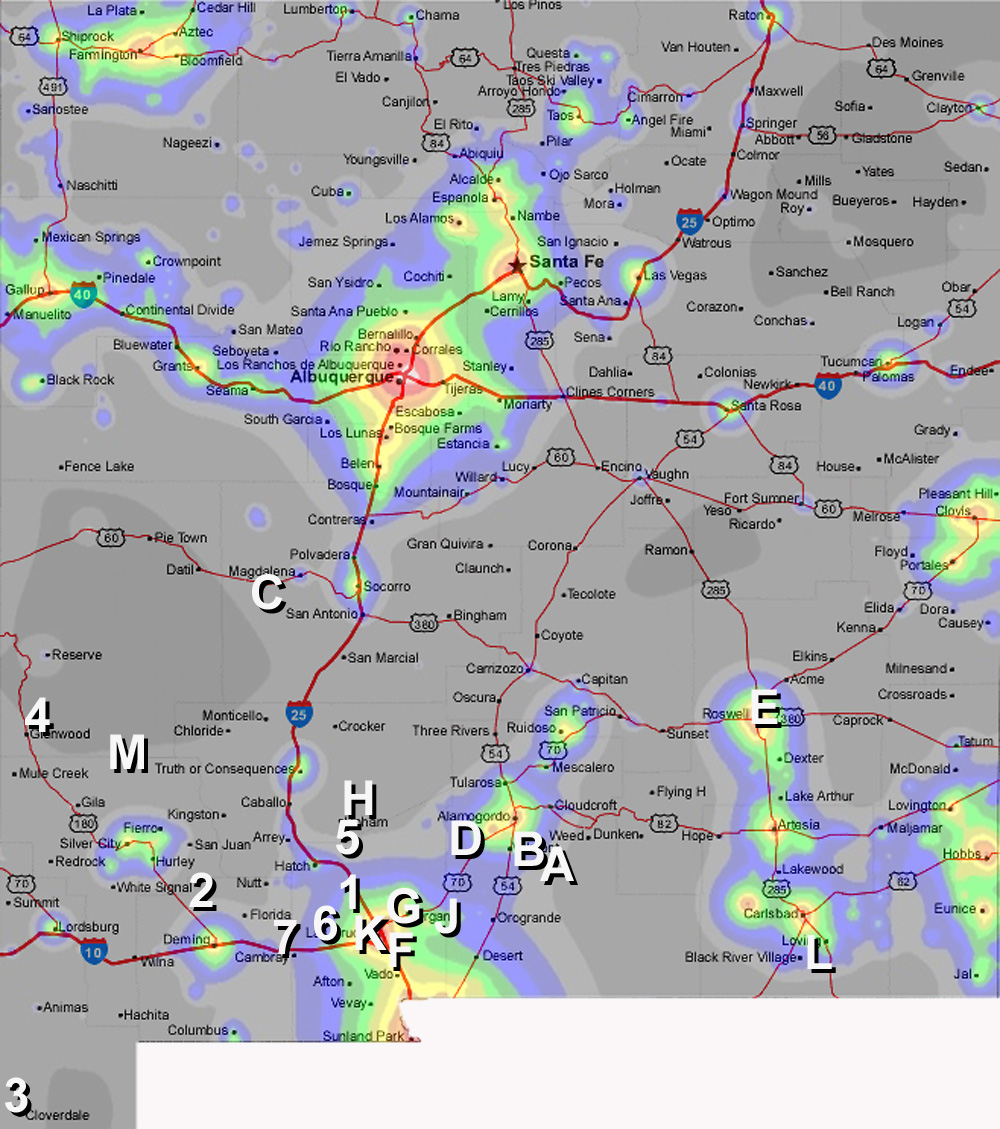 If you're considering a trip to the 'Land of Enchantment', please check out our visitor's guide for astronomy fans interested in visiting southern New Mexico. The majority of the state enjoys Bortle 0 or 1 skies, so finding nearby quality dark skies is something we (almost) take for granted. Several dark sky observing/imaging sites and space tourism locations are highlighted, and further described on the visitor's guide page. If you're considering a trip to the 'Land of Enchantment', please check out our visitor's guide for astronomy fans interested in visiting southern New Mexico. The majority of the state enjoys Bortle 0 or 1 skies, so finding nearby quality dark skies is something we (almost) take for granted. Several dark sky observing/imaging sites and space tourism locations are highlighted, and further described on the visitor's guide page.
There's also an email link in case you have additional astronomy-related questions about the area.
Nearly half of New Mexico is managed by the Bureau of Land Management (BLM). Dispersed camping for up to 14 days is permitted pretty much anywhere on undeveloped BLM land unless specifically prohibited. Please check current fire conditions before lighting a campfire, and dispose of all trash and human waste properly. More info here.
|




