Variable Star Measurements
Stars appear to shine with a constant light; however, thousands of stars vary in brightness. Broadly speaking, variable stars are of two types:
- stars that are intrinsically variable, that is, their luminosity actually changes, for example because the star periodically swells and shrinks
- eclipsing and rotating variables, where the apparent changes in brightness are a perspective effect
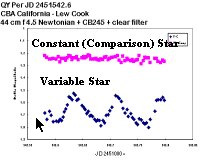 The behavior of stars that vary in magnitude (brightness) - known as variable stars - can be studied by measuring their changes in brightness over time and plotting the changes on a graph called a light curve. Amateur astronomers around the world observe variable stars and assist professional astronomers by sending their data to variable star organizations, such as the American Association of Variable Star Observers (AAVSO) in Cambridge, Massachusetts. One ASLC member has contributed well over 10,000 observations to the AAVSO!
Research on variable stars is important because it provides information about stellar properties such as mass, radius, luminosity, temperature, internal and external structure, composition, and evolution. This information can then be used to understand other stars. Professional astronomers work with only a handful of large telescopes, and so cannot gather data on the brightness changes of thousands of variable stars. Instead, it is amateur astronomers, utilizing small telescopes, who are making valuable contributions to stellar astronomy by observing variable stars and submitting their observations to the AAVSO International Database. The AAVSO coordinates, evaluates, compiles, processes, publishes, and disseminates variable star observations to the astronomical community throughout the world.
- from AAVSO website
Click here to read more about A.L.P.O. (The Association of Lunar and Planetary Observers)



