Mercury will be visible during early February in the west immediately after sunset. The planet then rapidly moves into the Sun's glare and won't be visible during the of the month. Inferior conjunction occurs 08Feb.
Venus is very low in the pre-dawn east at the beginning of the month. It will move into the Sun's glare early in the month and re-emerge as the evening star in mid-to-late April.
Mars is now the only bright planet in the evening sky. The red planet is slowly dimming, but remains positioned nicely for viewing throughout February.
Jupiter is lost in the Sun's glare until middle to late February when it re-emerges in the pre-dawn (eastern) sky.
Saturn (in Sagittarius) is about 30 minutes ahead of Jupiter. It also starts the month in the Sun's glare, but should appear in the pre-dawn sky a few days before Jupiter.
Outer Planets. Uranus and Neptune. Uranus is about 60 minutes ahead of Mars, so in a decent position for viewing throughout February. It will set around 11:30 pm. Neptune is very low in the west and will disappear into the Sun's glare during the month.
Pluto Our favorite dwarf planet remains nestled in Sagittarius. It's lost in the Sun's glare during February.
Comets, Asteroids and Meteor Showers:
Nothing to report for bright comets or meteor showers during February. As for brigh(ish) minor planets, (18) Melpomene reaches opposition on 01February. (29) Amphitrite is at opposition on 21 Feb. They'll shine at 9.6 and 9.9 magnitude, respectively.
Constellations and Deep Space Objects:
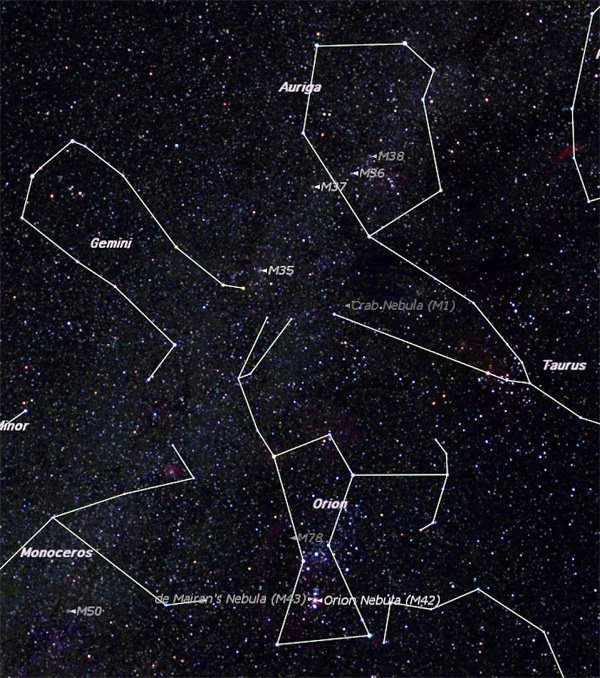
The winter Milky Way (below) dominates the February sky. Orion, Gemini, Auriga & Taurus offer several bright open clusters including M35, M36. M37, M38, M50. All are nice targets with binoculars. A modest telescope will offer an even nicer view. There are also a few good nebular targets including M42/M43 and M76 in Orion, and M1 (the Crab Nebula) in Taurus.